SBM Offshore: Subsea Mattress & Grout Bag Manufacture
Local subsea mattress & grout-bag manufacture · Mossel Bay, South Africa · 2012
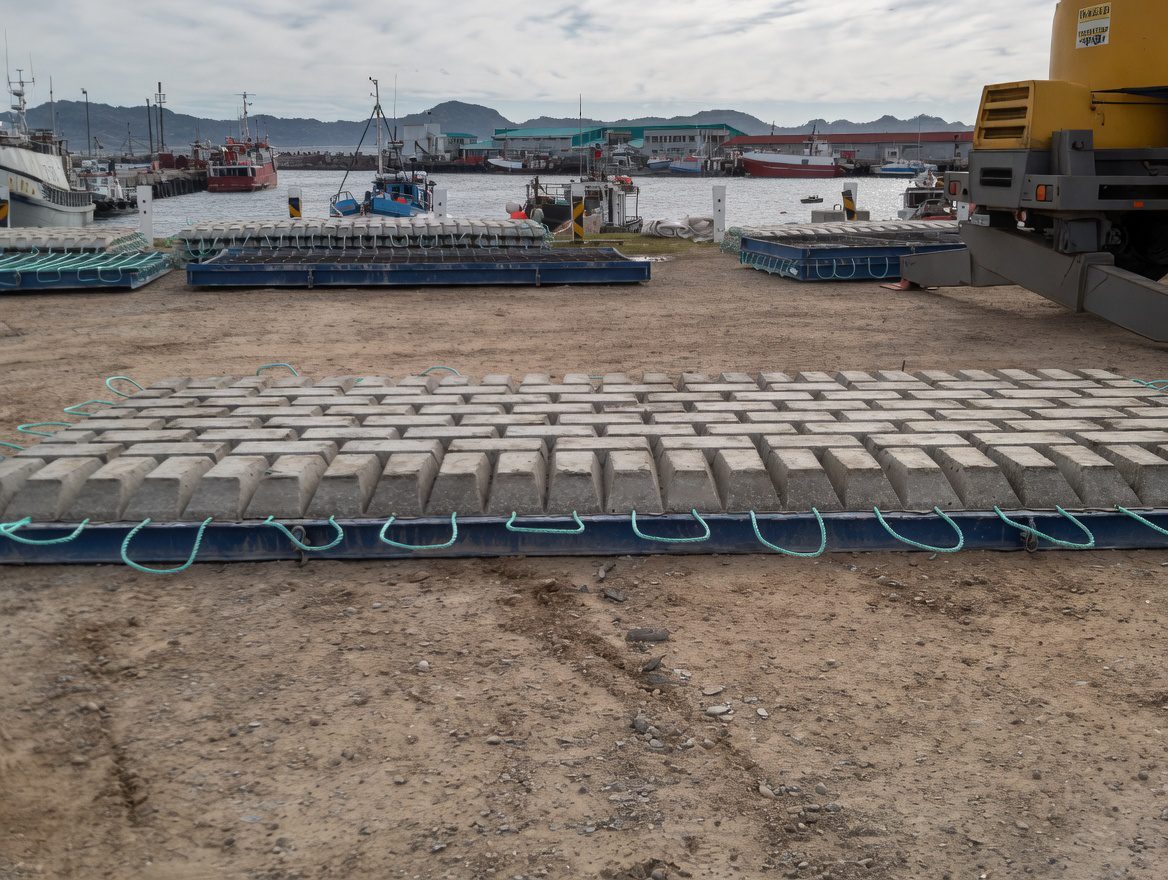
In 2012, for SBM Offshore's subsea construction scope on PetroSA's Project Ikhwezi (the F-O gas-field tie-back offshore Mossel Bay), Afrishore did what most of the industry imports for the subsea protection, and thereafter manufactured the mattresses locally. Rather than freight finished product in from established overseas yards, Afrishore stood up a complete casting and grout-batching capability on the Mossel Bay quayside, beside the offshore load-out, and produced 1,480 articulated concrete mattresses and 4,000 tonnes of subsea grout in bulk drop bags to international specification.
A subsea concrete mattress is a recognised engineering solution for protecting and stabilising pipelines, flowlines, umbilicals and cables on the seabed – an array of high-strength concrete blocks linked by a UV-stabilised polypropylene rope matrix that lets the unit articulate and conform to the seabed while adding the weight to hold subsea lines in place and resist scour. Each of the 1,480 units, nominally 6 m × 3 m, was cast on a steel mould fabricated locally to international (DNV-type) specification, using a proprietary high-strength ready-mix which was locally supplied. After curing, Afrishore's local crews threaded the rope matrix and formed the integral lifting loops by hand before each mattress was struck from the mould, finished and stacked for load-out.
Alongside the mattresses, Afrishore supplied subsea grout to the project: 4,000 tonnes batched and mixed locally and packed into subsea grout bags for offshore deployment. Subsea grout fills scour holes, free-spans and voids, beds and supports subsea structures, and provides ballast and stabilisation on the seabed: the complement to the mattresses across the protection scope.
Placing 1,480 heavy units accurately over live subsea infrastructure is slow and risky if it depends on divers. Afrishore commissioned and proof-load-tested a bespoke ROV-operable deployment spreader bar in Mossel Bay to mitigate this, and every lift at the yard ran to a documented safe system of work – trained banksman slinging, six-monthly competent-person beam inspection, a test lift before use, and controlled exclusion of personnel during lifting.
Project Ikhwezi tied PetroSA's F-O gas field back to the offshore F-A platform and onward to the Mossel Bay GTL refinery, with subsea installation carried through 2012. Pipelay was performed by the Allseas pipelayer Calamity Jane and the Jumbo heavy-lift vessel Fairplayer; the locally manufactured mattresses and bagged grout were deployed offshore by the Harkand construction vessel Da Vinci (now Boka Da Vinci), which draped the mattresses over the flowlines and set the grout bags on the seabed to resist the high-velocity bottom currents and wave-induced flow of the South African south coast.
The programme delivered its full scope of certified subsea product from a standing start, to the same standard as imported equivalents, without the import freight, lead time or handling damage – all while keeping the supply chain in the Southern Cape. Local concrete, local lifting and rigging, a 100% local workforce and a structured skills-transfer programme turned a procurement line into durable subsea-manufacturing skills on the Mossel Bay quayside. For an operator, that is the difference between buying a product and building a capability: Afrishore brought the factory to the quay.